The thing with the travel bug is that once you’ve been bitten, the urge to travel and explore the world starts to grow inside you and gets bigger and bigger with every trip you take..I was bitten by that bug a long time ago and I’ve found out that the condition also comes with a side effect, which presents itself in making one feel anxious and just plain ‘blah’, when you don’t have any trips booked. So you start ‘scratching the itch’ by scanning flights with the option to “take me anywhere”, and be sure – within the next few days you’ll have some tickets booked on your name. That’s exactly what happened to me beginning of January. I came to work. I checked the e-mails. I did some tasks. I checked my calendar. I checked the flights. I booked the flights..
Brace yourself: it’s going to be a long post (lots of pictures though!).
Why Singapore and Malaysia?
1) I wanted to go somewhere far and I was in need of some warmth and sunshine. I like winter weather in Estonia as long as there is proper snow as it makes bearing the ‘9 months of darkness’ a bit easier, but the weather has been quite indecisive this year – being unable to make a decision whether it’s going to stay in autumn mode until spring comes (read: cold, dark and rainy) or turn into winter (read; cold, dark and snowy).
2) I’ve been to Malaysia before about 7 years ago and I really liked the overall vibe there. Friendly people and beautiful nature – what more could I ask for. Visiting Cameron Highlands back then is still one of my favourite places I’ve ever visited – the tea plantations and just the amazing views from the mountains there..absolutely beautiful (previous post here).
3) I am not really picky about my travel destinations. I just want to see, explore and feel as much of the world as possible as being away (as well as coming home), can teach you a lot about yourself and others and life in general (yes, a cliché, but also true).
“Travel isn’t always pretty. It isn’t always comfortable. Sometimes it hurts, it even breaks your heart. But that’s okay. The journey changes you; it should change you. It leaves marks on your memory, on your consciousness, on your heart, and on your body. You take something with you. Hopefully, you leave something good behind.” – Anthony Bourdain
A good vacation for me includes the sea, some mountains and lots of nature and outdoors and Langkawi has all of those. Langkawi is a cluster of 99 Malaysian islands and is located in the Andaman Sea in Malaysia and off the western coast of Malaysia’s mainland. The main island, which is known as Pulau Langkawi, is the largest of these islands (‘Pulau’ actually means ‘island’ in Malay). The population of Langkawi main island is about 75,000 and the total population is close to 110,000, the majority are Malays (about 70%). There are also small percentages of Chinese, Indian and Thai population on the island. Langkawi has received World Geopark status from UNESCO due to its geological landscapes and formations.
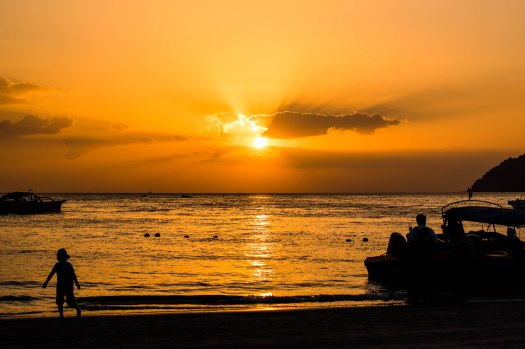
We stayed right at the Pantai Chenang beach. It was quite quiet and peaceful there during the day time as most people were exploring the island then, with only a few people swimming or sunbathing at the beach. But right before sunset, people started gathering at the beach as the sun sets on that side of the island, so you’ll get some beautiful views of the sun sinking into the sea. Even the Aiskrim (yes, that’s how it was spelled on his bike) man showed up by that time with a cooling box full of ice-cream, sorry aiskrim.. But after the sun had set, the main street was buzzling with people. Restaurants and bars were crowded and the music and entertainment shows started at the beach and didn’t really stop until 1 AM any of the nights we were there. So if you want some peace and quiet, maybe choose some resort or a hotel a bit further away. I didn’t mind the business. It’s part of the experience.
It’s not everyday I go on a hike that starts with the words “If you see a pile of leaves stacked up together – do not step on it. Do not go near it. Avoid it as there might be a king cobra sleeping underneath there. Or a viper or a python..”. Well, allrighty then.. I was so ‘glad’ I decided to wear shorts as we didn’t follow any paths or hiking trails and pretty much all of the jungle was full of piles of leaves.. But it was such a fun experience and luckily we didn’t encounter any snakes, so I would definitely go there again. The ‘local Bear Grylls’ Hisham was very knowledgeable about the jungle as he’s been trekking there for years. The trek took place in the bottom part of Langkawi’s highest peak (around 872 m) – the Gunung Raya. Even though 3.33 km hike might not seem much for a 2 hour trek, try doing that in a 38 degree heat going up and downhill with no trails and with a whole lot of bushes of rattan palms in your way, that have very sharp horns on them, so you can easily either get stuck on them or just scratch yourself, when you’re not careful.

Next morning we headed to Langkawi Wildlife park, which is a bit different from other zoos I’ve been to. It’s not very big. There aren’t a lot of big animals, but it has a really good vibe to it as the animals seem to be well looked after and cared for. Usually, when at the zoo, you can observe the animals through a glass or a cage, but here you can interact and feed most of the animals and birds and this made it really fun for me. Most of the animals there are small animals, who you mostly keep as a pet at home (well, I guess except the crocodiles), like rabbits and guinea pigs and a lot of different birds etc. Each of the area also has a park worker present, who can talk to you about the animals and what to feed them and to just make sure no one hurts the animals by mistake. In the bird garden the little birds just fly to you (whether you have food or not) and just chill on your shoulder..or head or hand.
But the main reason I wanted to go to the wildlife park was – wait for it – the raccoons. Yes, you read it right. I love raccoons! They’re one of my favourite animals, despite being referred to as trash pandas or thieves. They’re actually quite intelligent animals. From what I’ve read, raccoons actually rank above cats and just below monkeys on the mammal IQ scale. Not only are they able to be domesticated, they can often be taught skills the average human toddler would possess. They can survive and even thrive pretty much anywhere across the globe as long as there is a source of running water nearby. This level of adaptability is not found in many other creatures and is a characteristic of raccoons that makes them stand out. And their black masks do more than make them look like adorable outlaws—the mask helps them see clearly. The black fur works just like the black stickers athletes wear under their eyes. The dark color absorbs incoming light, reducing glare that would otherwise bounce into their eyes and obstruct their vision. At night, when raccoons are most active, less peripheral light makes it easier for them to perceive contrast in the objects of their focus, which is essential for seeing in the dark.
So long story short – meeting Sari the raccoon was a dream come true for me (yes, I have weird dreams like meeting a raccoon, so what?!) and made me very happy. She was just so soft and cute. She was obviously ‘a bit’ chubby and over-eaten, but she was very calm and relaxed, when in my arms (or maybe she was still sleepy as it was morning). When the care-taker handed her to me, she said “Hold her like a baby” and this furry baby I’d take home :). Even though they’re cute and I’d love to cuddle them all day long, I like that the wildlife park only has a designated time when you can do so, so the animals aren’t disturbed too much. And the wildlife park in general didn’t seem to have too many visitors, so hopefully the raccoons aren’t too stressed. I kept my cuddles short and let her go on and about with her business.
I’ve heard there are some raccoons already in the woods of Latvia..so maybe someday..one (or two..) of them will wander to my doorstep..and we live happily ever after.. ♥ ♥ ♥


Then another afternoon we went bird-watching with another set of local guides. This time from Junglewalla tours. When booking a bird-watching tour, you won’t really know if you’ll even see any birds or wildlife, but that what makes it exciting. For me at least.
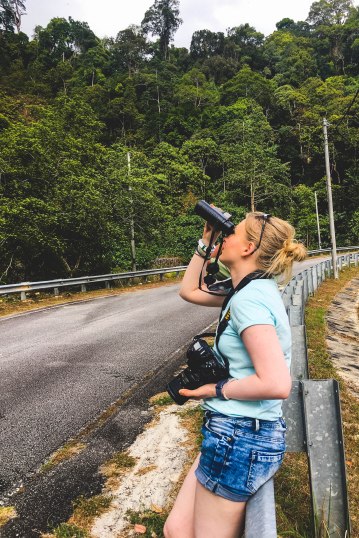 I’ve done some amateur level bird-watching in Estonia too (read: sitting outside my gran’s house in Southern Estonia for a few hours, hoping they’d come to collect the seeds I put in the birdhouse, so I can snap a photo of them..). It’s really calming and far more interesting than you might think as when a birdie flew there I hadn’t seen before, naturally I’d want to find out, who that was. So I had to do some research. But the guides in Langkawi knew the best places to go to, so we actually saw quite a lot of birds, even the great hornbills.
The great hornbill is a large bird – up to 130 cm long, with a wingspan of 150 cm and a weight of 2 to 4 kg. And they are long-lived (around 35 years in the wild or even more). In the wild, the hornbill’s diet consists mainly of fruit as they are predominantly frugivorous, but they’re also opportunists and will prey on small mammals, reptiles and birds, but figs are particularly important as a food source for them. In some cultures, hornbills are regarded to as a symbol of eternal love and fidelity as similarly to swans, they are monogamous and mate for life.


They took us to different places, but the best part was driving up the Gunung Raya mountain, where we had had our jungle trek a couple days earlier. As I already mentioned, this mountain is Langkawi’s highest top and it sure offers some great views. We got up there by driving, but there’s actually also a staircase of about 2000 steps that starts from the bottom of the mountain and if you’re after some good exercise, you can climb up there. Maybe put the “Eye of the Tiger” on as motivational music..


When visiting Langkawi, at one point you’ll definitely also meet the ‘furry security guards’ (or as the locals call them – ‘the mafia’), who’ll confiscate all your food and drinks without hesitation or further clarification. They are the crab-eating macaques and you can find them all-around Langkawi. A lot of newborns this time of the year! Despite their name, crab-eating macaques typically do not consume crabs as their main food source, but rather they are opportunistic omnivores, eating a variety of animals and plants. They’re most likely to approach you, if they see some food they can snatch from you. Other than that they seem harmless, but as I was told, they could become protective or aggressive, when you show them teeth as that’s a sign of threat to them.

The macaques have also developed a reputation for actively stealing items from humans (cameras, eyeglasses, hats, etc.), then refusing to return their stolen goods until given food in return. This unique form of kleptoparasitism (known as “robbing and bartering”) has primarily been observed in smaller groups of macaques living near tourist-heavy areas, suggesting it is a learned behaviour within social groups, in response to realizing that humans would trade food for their possessions back.
Another hidden gem is the Pulau Dayang Bunting, which is the second largest island in Langkawi’s cluster of 99 islands. It’s located south of the main island and can easily be reached by a boat. The literal meaning of its name is ‘the Island of Pregnant Maiden’.
The legend says that a man named Mat Teja met and fell in love with the princess Mambang Sari at the lake. They married and the princess gave birth to a son, however their son did not live long and soon died. Having reconciled with their misfortune, they decided to lay their son in the water of the lake and allow him to rest in peace. The gracious princess blessed all women having difficulty in conceiving a child – they would become fertile once they take a dip in the water of the lake.
To add to the mystery that surrounds the island and the lake, if you take a look at the hills that form the backdrop of the lake, from an angle it looks like as if a pregnant woman is lying there on her back.
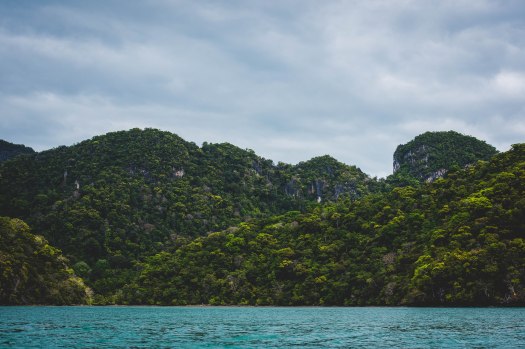
The entrance to the lake costs a few ringgits and if you want to swim in the lake, then you’ll need to have a life jacket on (you can rent them there) as the average depth is about 10 meters with no shallow areas. No one is allowed to swim there without a life jacket. I guess as it is so deep, a local Nessie could possibly be hiding there, but I’d meet her over a jellyfish anytime (no offence jellies). The only downside when going there with the “island-hopping” option is that you’re only given an hour there, but the island definitely deserves a longer visit. I would’ve wanted to swim there for another hour or two..
A little tip: they offer to rent life jackets for 5 MYR at the entrance, but if you go down to the lake, you can rent a life jacket there (which was better quality) for 1 MYR. Not a big difference, but as the lake is only a few steps away from the entrance, it was interesting to see how the prices would change..I’d imagine they’d be higher at the lake not vice-versa..
And a little recommendation for when you plan on doing some island hopping – choose a day that’s not too windy, as I got a little concussion from the boat jumping the waves. The boats are small and light and you’ll feel every wave. The driver didn’t really hold back on the gas either…
Spending the days in nature in Langkawi was so relaxing and good, but to really get all the stress out of my system, I also wanted a proper massage! 1st I wanted to try the foot reflexology. I’ve tried it in Tallinn, but it was more like a gentle massage than what I’ve heard a reflexology should be like. You can find massage parlors and reflexology places pretty much everywhere in Langkawi and Pantai Chenang and it’s very cheap – starting from 30 MYR (which is about 6-7 euros) for 30 mins. We stepped into a random one and even though I’d call it a good foot massage, I wasn’t convinced it was actually a reflexology, so I also wanted to try a different place. The other place was called the Teratai Reflexology and I’ll definitely recommend going there (you might need to book in advance though). It’s located towards the end of the main street of Pantai Chenang (when walking towards Pantai Tengah). And it was definitely a different class although only cost a few more ringgits. They actually gave me a reflexology chart to follow, so I’d know which spot means what. The last day there, we also went to the Ishan Malaysian Spa to get a full body massage. It’s a bit away from the Chenang area, but definitely worth going there (they offer hotel pick-up/drop-off as well). A perfect ending for a nice holiday.
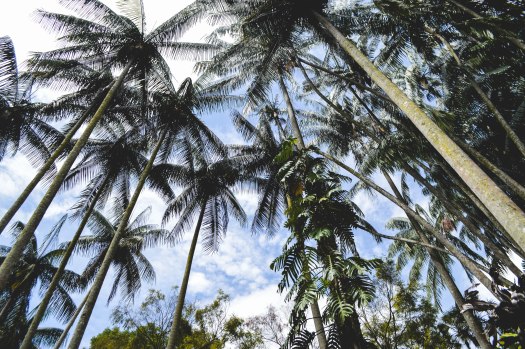
In short, Langkawi offered me all the nature and mountains and sea and wildlife I needed for a full relaxation, but Singapore was lovely too.
Some fun facts:
– Singapore is one of only three surviving city-states in the world (in addition to Monaco and the Vatican City). It gained its independence in 1965.
-The majority of the population are Chinese (about 75%), followed by Malays and Indians.
– In addition to its main island, the nation of Singapore includes 63 additional islands, most of which are uninhabited.
– Most of the people live in public-housing tower blocks.
– Singapore’s Bukit Timah Nature Reserve holds more species of trees than the entire North American continent.
– The Singaporeans can choose their own religion (meaning if you’re e.g. a Malay you don’t necessarily have to follow Islam, but can choose to follow Hinduism or any other religion).
– The most followed religion in Singapore is Buddhism. The Chinese-Singaporeans are predominantly followers of Buddhism, Taoism and Christianity with many irreligious exceptions. Malays are mostly Muslims, and Indians are mostly Hindus, but with significant numbers of Muslims and Sikhs from the Indian ethnic groups.
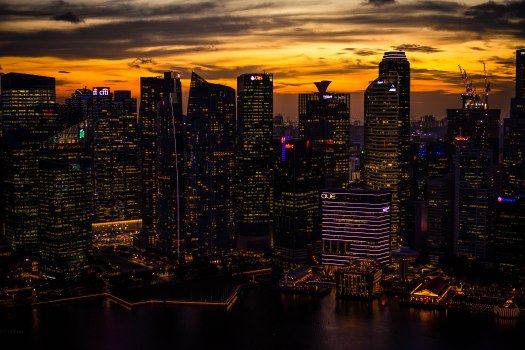
Whenever I travel, I want to find the highest tops, so I usually either climb some mountains, find a Ferris wheel (I love Ferris wheels!) or find a high building with an observation deck to visit. In Singapore, the Marina Bay Sands observation deck certainly offers some great views. We went there in the evening, about an hour before sundown, so we could see the city both in daylight and in nightlights. Fun fact: the buildings in Singapore can’t be higher than 280 meters (Marina Bay Sands is only 207 m high), because a military air base is situated really close to the central business district and high buildings could cause trouble for the planes.
Earlier that day we met up with Chris, who’s a local guide there and he took us for a walk around the neighbourhoods of Chinatown, Little India & the Arab quarter. I always like to talk to the locals a little, because this is how you really get to know a country and their culture. They tell you about local life and show you places you might not discover by yourself. The Chinatown in Singapore is quite different from other cities’ Chinatown areas I’ve been to. Most of the temples there were built quite recently (only a few decades ago) with the purpose to attract more tourists. Usually you know that it’s Chinatown by the fact that there are these red paper-like lanterns put up across the street, it’s filled with different food stalls, the street is crowded with people etc. But it wasn’t nothing like that there. There were some pink lanterns. Some people. Some souvenir stalls and that was about it.
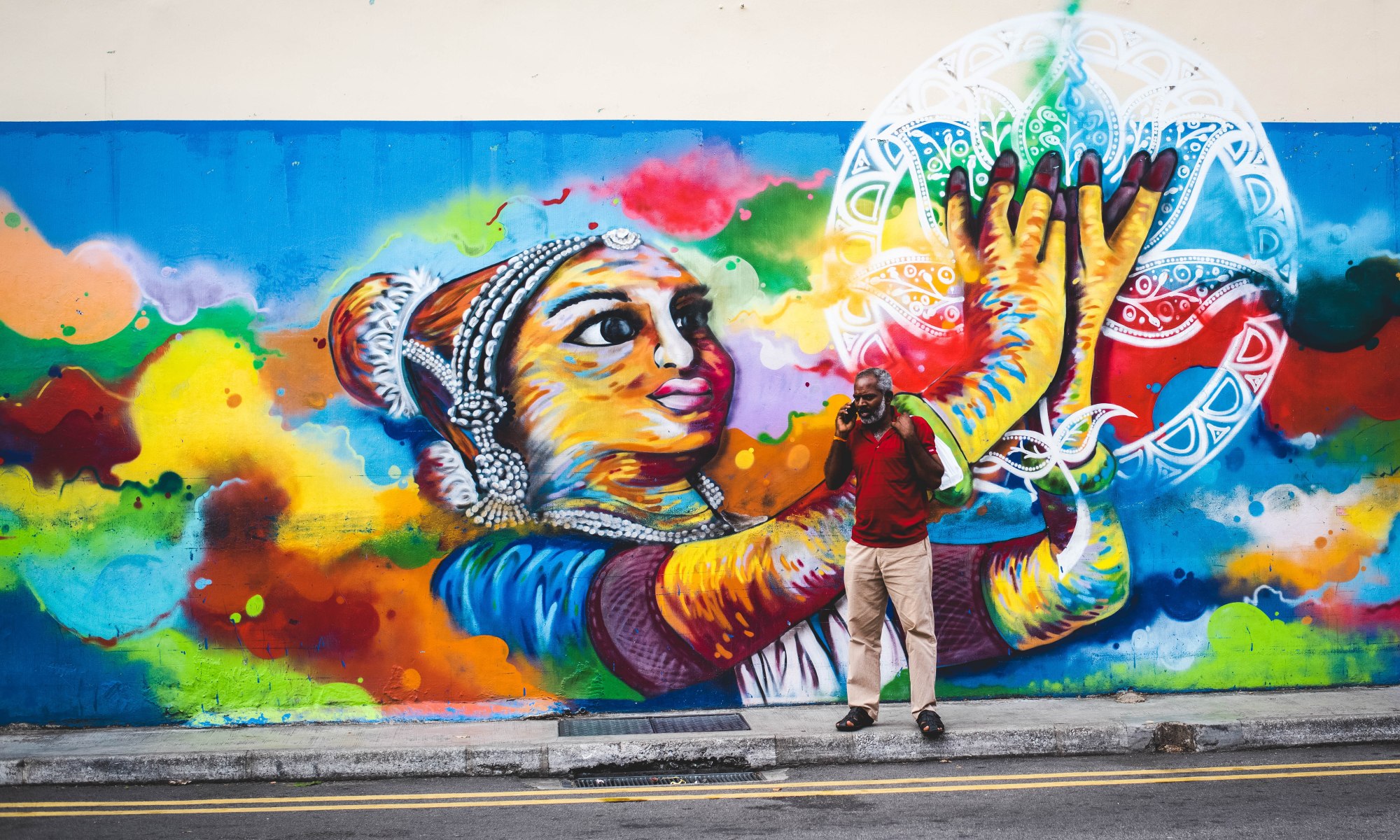
Then we headed to Little India, which is filled with colourful houses and beautiful wall murals, but my favourite place was the little street of Haji lane in the Arab quarter. A perfect place for an artist – full of colours and life. A lot of different cafes and restaurants there too. Definitely a place not to miss when in Singapore.


Tip: Commuting around Singapore is very easy. We mostly used the MRT as it was clear and quick. You can buy the tourist pass to use the public transport or you can just use your bank card if you’ve enabled the swipe payment to enter the MRT stations as they just deduct the ticket price directly from your card and there is no need to buy a ticket from a kiosk or a ticket machine. You just swipe it when entering and exciting.
Even if you’re not a flower or plants enthusiast, the Botanical Gardens is worth a visit. It’s huge! And it’s gorgeous! Especially the orchid garden. The entrance to the orchid garden costs a few dollars, but aside from that the entrance to the gardens is free and it’s a perfect place if you just want to get away from the city. We spent hours walking around there. You’ll notice some roosters and hens and swans and about a meter long lizards (yikes!?) walking around there freely, but they all seemed friendly. I’m fairly certain the lizards (or whoever they were) were herbivores (or at least I want to believe so…).
Singapore also has some somewhat uncommon laws. For example:
– Chewing gum is banned in Singapore. Yes, you read it right. You can’t buy/sell or bring chewing gum in to the country unless it’s for medical purposes. The first-time penalty for the selling of gum can be as high as $SG 100,000 or even a prison sentence.
– It’s against the law to annoy someone with a musical instrument. Singapore’s statutes state that playing an instrument in a public place in “a manner as to cause or be likely to cause annoyance to any person lawfully using a public road or in any public place shall be guilty of an offense” that includes a fine of up to $1,000.
– If you’re caught singing or uttering songs in any public place that have obscene lyrics, you can face imprisonment for up to three months or a fine.
– Wandering around your house nude with any open curtains can land you a fine of $2,000 or imprisonment for three months. Or both. Didn’t flush the toilet?! You could be fined of around $150.
– Spitting on public roads can land you a fine of up to $1,000.
– Want to feed your left-over breadcrumbs to the pigeons?! Think again. Feeding the birds can cost you about $500.
– In Singapore, jaywalking is defined as crossing the road within 50 meters of a crossing zone. It can be fined up to $1,000 or even three months of jail time. The punishment doubles to a fine of up to $2,000 and six months in jail if you’re caught jaywalking twice.
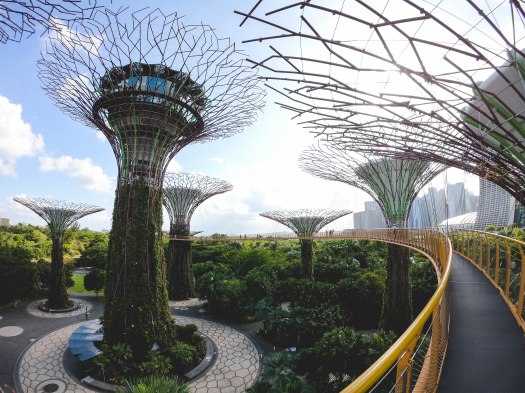
Singapore was actually quite different from what I thought it would be. I imagined it to be something like New York or London – busy streets filled with lots of people rushing to meetings and work etc. But it wasn’t like that at all. It was calm. There was actually room to walk! The traffic was normal (no honking!). No rushing in the subways. There are lots of green areas. It was beautiful.
In short, it was a much-needed and awesome vacation. The flight from Helsinki to Singapore went by very quick as well, as it was a night flight (both ways), so I pretty much slept through most of it (and watched the new Terminator movie..spoiler alert: I don’t think he’ll be back anymore..).
And now I am back in the position where I have no flights booked.. Where to next?!
A.
“Travel makes one modest. You see what a tiny place you occupy in the world.” – Gustave Flaubert
 AT VISUALS PHOTOGRAPHY