
So I’ve been doing some bird-watching (amateur level) in the last couple of days in the parks nearby my home in Tallinn (Estonia) and I’ve managed to spot and snap photographs of surprisingly many different birds.
Bird-watching is quite exciting in my opinion, as you might hear the birds sing from far away, but it’s not easy to spot these little ones as they are quick and usually sit quite up high on the trees. You just have to follow their song and then, if you’re lucky, you’ll spot them. But then after you’ve spotted them, trying to take a photograph of them is a sports in itself – you can’t make any sudden movements or else they fly away. So you have to be really patient as well.
Birds are most active twice a day – in the morning when the sun comes out and in the afternoon before it gets dark again, so you don’t necessarily have to be a morning person to see some birds (luckily for me). During midday they may be having a siesta, but I’ve taken most of these photographs around 4-5 o’clock in the afternoon and managed to see quite a lot of different birds. Also you don’t have to drive out of the city and go deep into the woods to find them. There actually are other birds than pigeons, crows and seagulls in the city parks too.
The 1st birdie I spotted was the European Robin (Erithacus rubecula). Fun fact: The distinctive orange breast of both sexes contributed to the European robin’s original name of redbreast (orange as the name of a colour was unknown in English until the 16th century, by which time the fruit of that name had been introduced). In the 15th century, when it became popular to give human names to familiar species, the bird came to be known as robin redbreast, which was eventually shortened to robin.


Chaffinch (Fringilla Coelebs) is a common and widespread small bird in the finch family. The male is brightly coloured with a blue-grey cap and rust-red underparts. The female is much duller in colouring, but both sexes have two contrasting white wing bars and white sides to the tail. The male bird has a strong voice and sings from exposed perches to attract a mate. Fun fact: In winter all-male chaffinch flocks are not unusual, giving it an old country name of bachelor bird.


The Eurasian Siskins (Spinus spinus/Carduelis spinus) are also members of the finch family with yellow, black and green colouring. They have yellow colouring most prominently on their heads, breasts, wing stripes, rumps and the edges to their tails (similar to the tail markings of the Greenfinch). Their flanks are marked with distinct dark streaks. Fun fact: Males have black caps and small black bibs. Females’ caps are greenish and streaked. Females have no black bibs.


The Eurasian Nuthatch (Sitta europaea), also known as the “upside down” bird, is often observed walking headfirst down tree trunks, while searching cracks and crevices for insects. The name nuthatch is derived from nut hacker, reflecting the bird’s method of opening up nuts by jamming them into a crevice then hammering at them. There are 24 different species of nuthatches in the world. Fun fact: no sightings of nuthatches has been reported in Ireland.


The Eurasian bullfinch (Pyrrhula pyrrhula), common bullfinch or bullfinch, is also a small bird in the finch family. In Anglophone Europe it is known simply as bullfinch, as it is the original bird to bear the name bullfinch. They form strong, lasting pair bonds and it’s usual to see birds in pairs throughout the year. The bullfinch is one of our shyest garden birds, which may explain its reluctance to visit feeders. Fun fact: Bullfinches were once popular cage birds, because they can be taught to imitate a special bird flute or whistle.

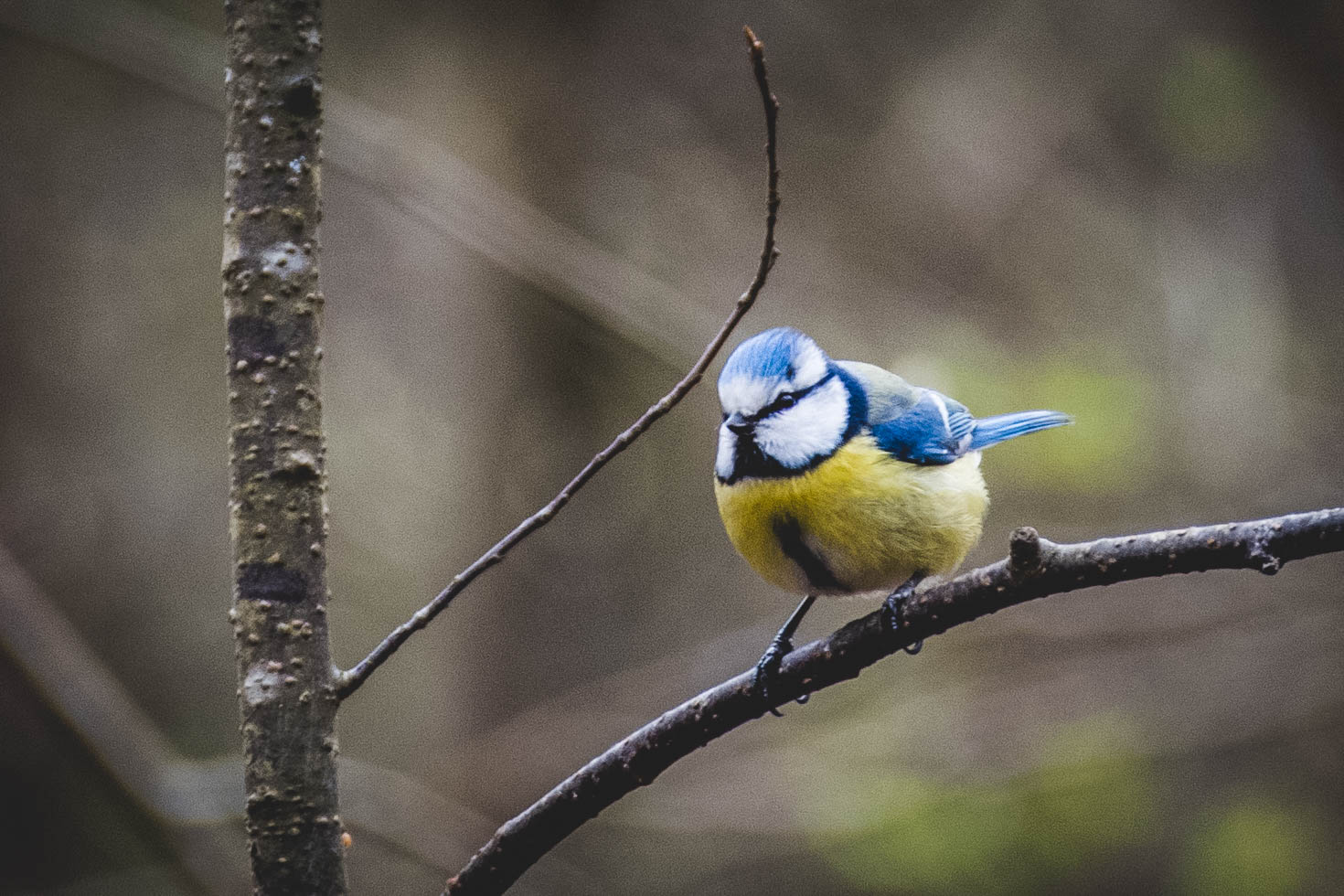
The Blue Tits (Parus caeruleus/Cyanistes caeruleus), usually resident and non-migratory birds, are widespread and a common resident breeder throughout temperate and subarctic Europe and the western Palearctic. They usually nest in tree holes, although they easily adapt to nest boxes where necessary. Their main rival for nests and in the search for food is the larger and more common great tit. Fun fact: At the beginning of the 20th century, blue tits learned to remove the foil from the bottle of milk and collect the cream located on the top. When a practice of milk delivery became obsolete, blue tits returned to their original food sources.


The Great Tit (Parus major) is the most widespread of all the species of tit. It is found across almost all of Europe and east to Japan and south to Indonesia and also in North Africa. Fun fact: The male’s distinctive double-note song is one of the most familiar sounds of spring. There are, however, a huge number of variations of the song and a typical male great tit will use around 40 variations. It has been found that the individual birds with the greatest repertoire of songs enjoy the most success with the girls.


The Yellowhammer (Emberiza citrinella) is a bird in the bunting family that is native to Eurasia and has been introduced to New Zealand and Australia. Most European birds remain in the breeding range year-round, but the eastern subspecies is partially migratory, with much of the population wintering further south. Fun fact: Yellowhammers produce monotonous songs, made of short notes that repeat rapidly. Rhythm of the song is often described as “a-little-bit-of-bread-and-no-cheese”. Males learn songs from their fathers.

Great Spotted Woodpeckers (Dendrocopus major) chisel into trees to find food or excavate nest holes, and also drum for contact and territorial advertisement. It’s easy to tell the sexes apart, as only the male has the patch of scarlet on the back of the neck. Fun fact: Woodpeckers have shock-absorbent tissue between the base of the bill and the skull to cushion the impact of drumming.


Eurasian Jays (Garrulus glandarius) are members of the crow family, about the same size as Jackdaws. Their colouring is mainly pinkish grey-brown, with distinctive bright blue, black and white patches on their wing coverts. Fun fact: Jays are noisy and can make a variety of squawks and screeches. The most common call is a harsh “aaaack-aaaack” made when alarmed, agitated, or in flight, usually with 2-3 repetitions of even length. Some mimic calls, particularly of predators such as hawks and owls, are also part of these jays’ repertoire.


Among the birds, some red squirrels stopped by to see what I was up to as well. Seemed only fair to snap some photographs of them too.


Red squirrels (Sciurus vulgaris) occupy coniferous woods in Siberia and northern Europe. In southern and western Europe they live in broad-leaved woods, where there is a better source of food year round from the mixture of trees and shrubs. Red squirrels are largely vegetarian. In most parts of the British Isles as well as Italy, broad-leaved woodlands are less suitable now because of competition from the introduced Grey squirrel. Both species of squirrel are surpisingly good swimmers. Fun fact: Red squirrels can find their buried food in more than 1 foot (approx. 30 cm) of snow.
I know this last photo is totally out of focus and blurry, but for some reason I still like it. Maybe because even though it’s blurry, I can see the “catch-me-if-you-can” look in his eye.

Sincerely,
A.
(the crazy bird lady)
 AT VISUALS PHOTOGRAPHY
One Reply to “”