
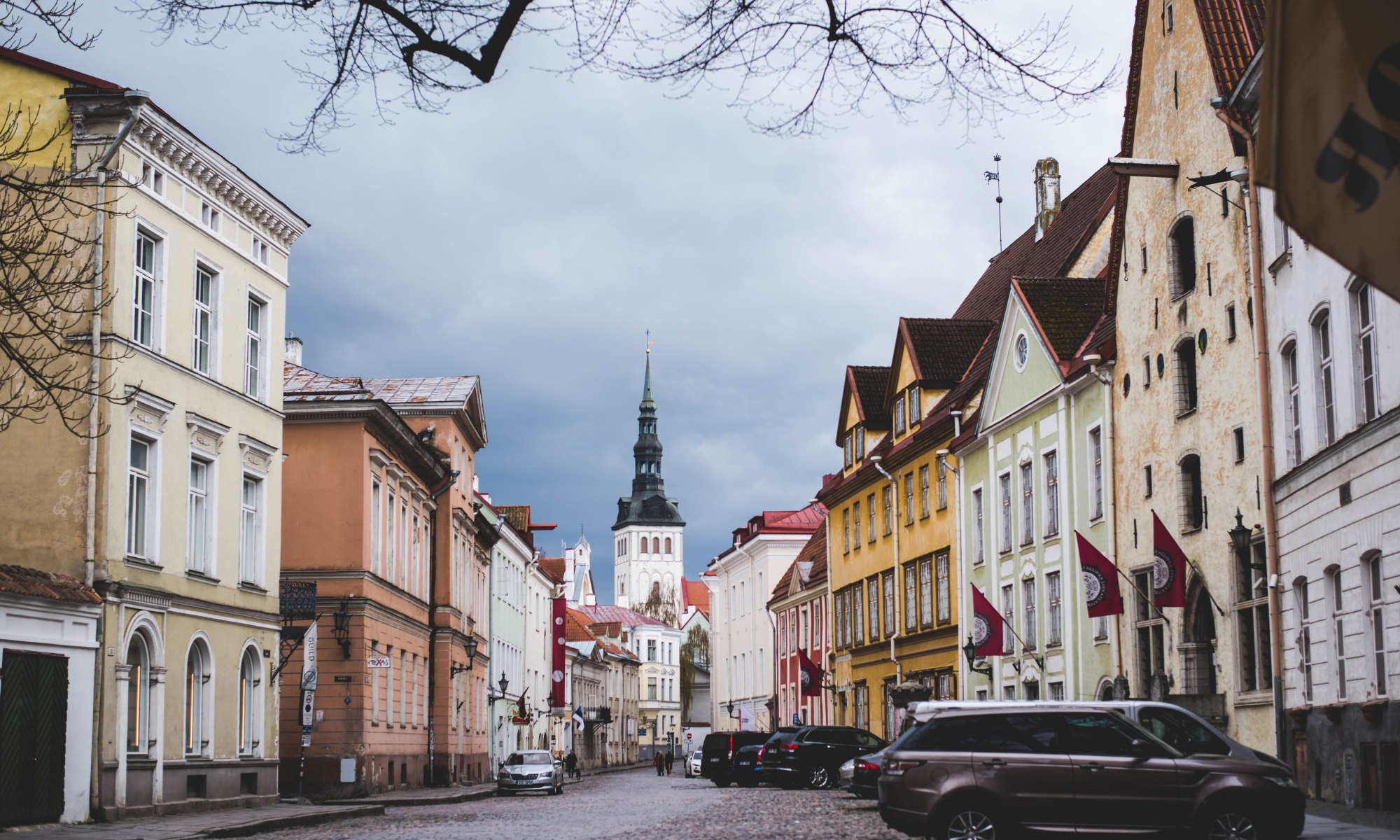
I went for a walk around Tallinn Old Town on Sunday afternoon and it is quite rare to see the Old Town so empty. Even if it’s not a tourist season, there’s usually many people walking the streets and running their errands, going to some café or a restaurant or just having a walk there. But now, when you wait for a minute or two, you can have the street completely to yourself.
It’s been a strange few months all around the world, where we’ve had to adjust to constraints and lockdown measures to control the spread of the Covid-19 virus. In Estonia, all the schools, gyms, malls and cinemas etc have been closed, flights and ferry rides cancelled and the border crossings restricted. I just drove by Tallinn airport the other day and I’ve never seen such a huge amount of planes grounded there at once. When in public areas, both outside and inside, people have to follow the 2+2 rule: keep a distance of at least two metres with others and move in individual groups of no more than two people. These restrictions will be in effect until mid-May (or until the situation changes). But in Estonia at least, these measures seem to be working, as in the recent days only a few new daily infections have been confirmed. Hopefully there will be none new ones soon.
I used an old film camera and a black and white film to document this time, so all the black and white photographs are taken with my Konica TC-X, which is about the same age or slightly older than me (those cameras were produced between 1985-1987). Mid-way down the post, you’ll find some digital colour photographs too to end on a more vibrant note.
If you want to know why I chose a black and white film instead of a coloured one, read one my earlier posts – A Perfect Lie – where I explain, what I love about black and white photographs.
Usually around 1.5 million people visit Tallinn each year, including more than half a million cruise passengers. In the summer months, the streets of Tallinn Old Town are usually packed with tourists, and especially with cruise passengers, as the Old Town is only a short walk or drive away from the harbour. But at the moment, the streets are almost completely empty.


Café Maiasmokk is considered to have been established in 1864, although already in 1806 there was a small bakery and a shop at the same location. It is the city’s oldest running café. Literally translated, the name means Sweet Tooth – an appropriate name for the delicious home baked goods served here. It even houses its own Marzipan Museum.

The Snelli pond is the only part that has survived of the ditch that once surrounded the city (this part was dug in the 1760s). The park has a diverse selection of trees due to the ground relief and planting the park in several stages and at different times.


On Town Hall Square you will also find the Europe’s oldest continuously operating pharmacy, the Raeapteek (open since 1422). Today it operates as a museum and modern pharmacy. Some outdoor cafes were also open in the Town hall square and some people were enjoying the Sunday sun and some coffee there.

Some fun facts about Tallinn:
– Tallinn is not often thought of as a beach city, however, the Pirita District offers about 2 km of unspoiled sandy beaches with beautiful views out to the Baltic Sea.
– Under the Old Town is a labyrinth of 17th century tunnels, but it was not widely known about to visitors until 2010 when many of the passageways were opened to the public.
– It is almost impossible to see all of the city’s five medieval church spires at once. A little known secret is that if you find a particular circular stone on Town Hall Square, there is one spot where you can do exactly this. Look out for the cleverly positioned hole in one of the roofs, and make sure you find the correct stone as there are some fake ones just to throw you off track.
– Chimney Sweeps in Tallinn continue to wear 19th century uniforms. If you come across one, be sure to touch his brass buttons, because the myth has it that it brings good luck.
– The Estonian’s sense of humor is often hard to figure out and regarded to as being close to the British.
– Kalevipoeg is the country’s national epic. It tells the story of a giant hero who throws stones and talks to hedgehogs.
– Estonian have the biggest collection of folk songs in the world with written records of 133 000 folk songs.
– Once every five years the Estonians gather for a weekend in Tallinn for a manifest of pride for their country through singing and dancing during the Song and Dance Festival.
– The events that led to the restoration of Estonian independence from the Soviet Union in 1991 are commonly referred to as the Singing Revolution. The term was coined following a series of mass demonstrations during which Estonians sang national songs and patriotic hymns that were strictly forbidden.
– There’s an Estonian saying: “Parem varblane peos kui tuvi katusel” and the point of this quote is to have less, but to have it for real, with the exact translation stating, “It’s better to have a sparrow in your palm than a dove on your rooftop”.


If you want to know more facts about Tallinn, you can find an in-depth brochure here, published by the Tallinn City Enterprise Department.
Not sure what these graffitis are about, but found a few of those on different buildings and locations around the Old Town.


But to be honest, the highlight of my walk was seeing this cool cat, also on a walk around town.

Hope you’re all well!
Sincerely,
A.
 AT VISUALS PHOTOGRAPHY